
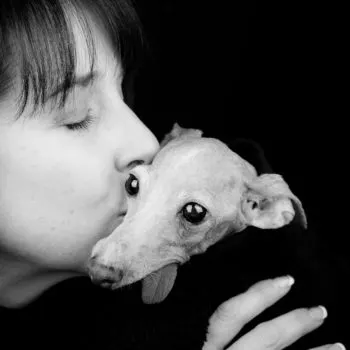
In the first four or five months that Pam Horton had Lil Olive as a companion, both spent lots of time on the floor. As the dog cowered, a reaction bred by 15 years in a puppy mill, Pam would get down to her level. She wouldn’t look Lil Olive in the eye — mill dogs tend to perceive that as threatening — but she would talk to her.
“I would say, ‘You and I are going to stop this. I promise you.’” Horton remembers.
It was then, well before any talk of A Voice for Lil Olive, that Horton committed to helping create a legacy for Lil Olive. Of course, stopping puppy mills is at the heart of her vision, but over time it’s become about more than that, too. Today, an essential element of that legacy is in celebrating the triumph of spirit — both Lil Olive’s and that of what Horton calls her Facebook pack family.
It’s fair to say that in those early months, Horton couldn’t have seen this second element coming. Even after Lil Olive grew into trusting her, the dog struggled to eat and drink, because of her jaw having rotted in captivity. Her thin skin would tear when she was picked up in certain ways. She waddled instead of walked, because of hip damage accumulated from birthing more than 20 litters.
And yet.
“She was the happiest dog I’ve ever seen, once we got her past being afraid,” Horton says. “She just wagged her tail all the time, she greeted people. She was able to put a lot of it behind her and enjoy her life.”
After a while, Lil Olive would even allow Horton to pick her up and pass her to friends. What often happened next had almost a mystical quality to it.
“They would look at me and say, “Why am I crying when I’m holding this dog?” Horton remembers. “I called it ‘being Olived.’ I think you could feel from her the experience that she had, and also feel from her that she was like, ‘It’s OK now.’”
Facebook proved that Lil Olive could also touch people through a computer screen. When Horton posted videos, pictures and stories there, followers responded and shared the content — and that, Horton says, is just as important as her posting in the first place.
“If I’m typing it and nobody’s involved and nobody’s reading it and no one’s being touched by it, then it’s not getting anywhere,” she says. “So these people are all her voice. She would not have it if it weren’t for them. I always told everyone that Olive belonged to all of us.”
Three years later, the community counts more than 41,000 people. Horton still sounds awestruck over the encouragement, gifts and inspirational messages she regularly receives, which allow her to believe she’s moving closer to her goal of making a real impact.
“I heard all the time that Olive became the face behind the puppies in the puppy store, and that if you’re looking at these cute puppies, you need to look behind them, because this is what is behind them,” she says. “I think Olive was able to do that because she embodied, sadly, the emotional issues and the physical.”
Continuing to remember and talk about those issues isn’t always easy, especially while doing something as intense as making a film. But a symbol never sleeps, and Horton believes that both she and Lil Olive have to stay in the public eye. Her commitment to helping Lil Olive build a legacy has never wavered. In fact, she says, “It’s the last thing I said to her — that I would never stop speaking out.”
— Kirk Woundy